Tag Archives: arts integration

Blackout Poem Maker

In one my previous posts, I mentioned how I integrate literary arts in the form of erasure poem in my both English and Turkish classrooms. Now that we have an idea of found poetry, erasure and blackout poems, I will introduce you to a new online tool “Blackout Poetry Maker“.

3 sample texts are available on the website to work on. We can also paste the text of our own choice on the box given. After that, we select the words that we want to keep. Then, click “black out.” We can save our poem as an image with a click on “Render Square”.

Text Source: Pride and Prejudice

We can ask our students to create their black out poems to practice the target language by considering some grammar objectives. We can ask them to have some specific structures learned in class such as Relative Clauses, Noun Clauses and Passive Voice. This activity also gives them the chance to practice vocabulary (word formation, collacations, adjectives and adverbs etc.) in a creative way.

Let me remind you the steps we follow while creating our blackout poems:

“In the end, creativity isn’t just the things we chose to put in, it is the things we chose to leave out.” -Kleon

Austin Kleon Blackout Poems


Surveillance Society

For many people, there is a slight line between street art and vandalism. But integrating them into our lessons will give us at least one reason why we should perceive them as creative art movements.

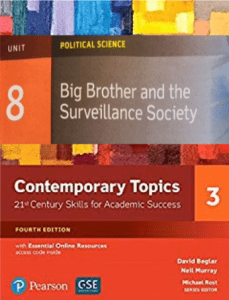
We use the coursebook “Contemporary Topics 3” to improve students’ listening skills, and it was the time for me to cover “Unit 8: Big Brother and the Surveillance Society” in which students watch a political science lecture.

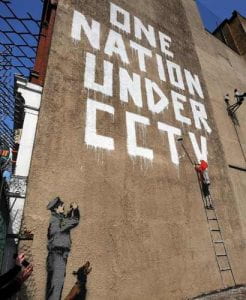
I started my lesson by sharing a street art artwork by Banksy, who is a well-known British street artist, to lead them into the topic.

a protest by Banksy against Britain’s surveillance society

Students described what they saw in the photo (One Nation Under CCTV) and made predictions about the topic of the unit.

At the warm-up stage of the lesson, I asked them to think about the cameras we have on campus. Then, I showed one another artwork by Banksy, and asked them to answer the question (What are you looking at?) on it from the perspective of the cameras.

At the prelistening stage of the lesson, we went on with learning new vocabulary for the lecture they would listen. After listening to the political science lecture on the increasing use of surveillance systems in the world, they answered the follow-up questions by using the notes they took at the time of listening.

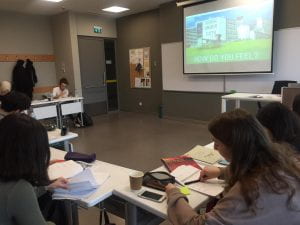
Gaining more knowledge and having the neccessary vocabulary to express opinions on the topic, students were asked to answer the question in the photo below.

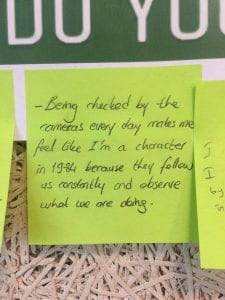
I’m sharing some photos to illustrate the work produced on the classroom wall at the end of the lesson.  Commenting on their friends’ responses on the post-its, they seemed to be enjoying the process.

It was exciting to see one student integrating another piece of art into his response, and it inspired me to use the dystopian novel “1984” by George Orwell for another lesson on a relevant topic as well as the obey stancil.


Some examples of street art by my students :


Collective “I AM POEM”

Creating a sense of community in the classroom is crucial, and it requires time and effort from all of us. There are various activities and practices that can help us achieve this goal, but incorporating artful teaching practices can truly strengthen the bond among your students.

I recommend trying this approach with at least intermediate students, after integrating some artful teaching practices in the first few weeks.

STEPS:

Let’s get creative and share a little bit about ourselves!

Ask your students to write an “I AM” poem using the following guidelines:

  • Brainstorm ideas about what to share. What makes you unique? Who are you?
  • Start with a strong first line that grabs the reader’s attention.
  • Use adjectives to describe yourself, including personality traits and emotions.

After writing their poems, have students bring them to class and read them aloud in small groups. Next, distribute two pieces of paper to each student and ask them to write down their two favorite lines from their poems that they feel describe them best. Collect the papers and place them on a table, allowing your students to work together to arrange the lines in order to create a “Collective I Poem” for the class.

This fun and creative activity will allow your students to express themselves while getting to know each other better. Let’s see what unique and interesting things we can learn about each other through our poems!

4. Students read their own lines in the poem and record it.

Check out this example from one of my English classes where each line belongs to a different student:

I AM POEM` ~~~ Collective

I’m an avalanche which falls from the mountains,
Stubborn and ambitious storms of the oceans.

I’m son of the seas
When I want to achieve my dreams.

My life… my hopes… my body… won’t disappear

although I am a ship which is lost in the sea of despair.

I know I will come back here before I die.

That tells me this is not a goodbye.

I will freely fly like a bird with the desire to travel around the whole world

I wonder why time is not enough for a dreaming traveller.
Then, I start to feel like a monster.

I love hugging people like a koala hugging tree

Because I am a lovely person who is free.
I always act logically but decide emotionally.

I wonder where I will be.

No one can judge me.

I want to see positive things in my country.

Who am I? Maybe the lonely star wandering in the sky.

Or the upcoming spring that cannot be prevented.

CLICK ON THE LINK TO WATCH THE VIDEO

♥ I would like to extend my sincere gratitude to Patricia Sobral, Anna Santucci Leoni, and the class of POBS Artful Teaching (Brown University; Spring, 2016) for the inspiration.

Monologue with an Object

Having artful practices on a regular basis in language classrooms has a positive effect on students learning in many ways. If you have students in need of more practice to overcome the fear of making mistakes, especially in speaking, the “Monologue with an Object” activity can be an alternative solution to address their need.

Towards the end of the semester when my students felt more confident with their language skills in A2 level, I asked them to prepare a monologue with an object of about 2 minutes. They were given the option to prepare the monologue from their point of view or the object’s to help reduce stress. Having the necessary rehearsals, they performed their monologues in the classroom. 

I can share a few notes based on my observations:

  1. Both in the performing stage and in listening to others, they concentrated their attention on the monologues. 
  2. Having an object and being given the option to make it speak lessens their anxiety of speaking in front of others.
  3. The flexibility provided on the content of the monologue boosts their creativity.
  4. Introducing an object of high importance built a connection among the students. 

♥ I would like to extend my sincere gratitude to Patricia Sobral, Anna Santucci Leoni, and the class of POBS Artful Teaching (Brown University; Spring, 2016) for the inspiration.

The Wheel of Happiness

As a follow-up activity of a unit theme “Happiness,” students shown the painting “Home Sweet Home” by Dianne Dengel were engaged in creative thinking to find out the factors that lead to happiness .

“Home Sweet Home” by Dianne Dengel

Then, they narrowed the list down to 12 factors through critical thinking. Each student enthusiastically worked on one factor of happiness that would be one piece of the whole wheel.

In the end, they expressed how the way the wheel looked  was far beyond their expectations. Knowing that it would be representing their values of happiness on the classroom wall, they dedicated hard work to complete it. 

Acrostic Poem

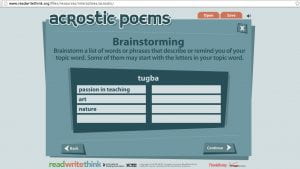
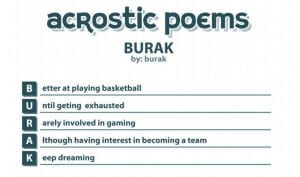
ReadWriteThink is a cool website providing educators with language teaching materials. We can ask our students to introduce themselves by writing their acrostic poems. What they need to do is to use the letters of their names to start each line.


This tool enables our students to brainstorm on the topic -themselves- first.

Then, they are provided with some hint words to begin their lines. Completing their acrostic poems, they can save and share them with you through email.

We can either introduce it in class and ask our students to write their acrostic poems as homework and bring the hardcopy to the class or have them write their poems in class and share with us. At the end of the process,  sharing poems in class would give us the opportunity to get to know our students with more details while they realize their creative potential within themselves.

 

Puzzle Art

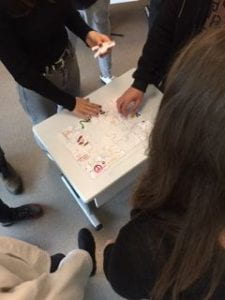
This is a community-building activity called “puzzle art” that can be implemented on the first day of school. It involves each student drawing something about themselves on a puzzle piece, then standing up to introduce themselves to the class by explaining the symbols on their piece, which helps to build a positive and inclusive classroom environment.

Puzzle Art for Community Building

Here are the steps for implementing “puzzle art” on the first day of school:

  1. Google a 12-piece puzzle template and print it out, based on the number of students in your class.
  2. Cut the puzzle pieces and distribute one to each student, including yourself if you want to be a part of the classroom community.
  3. Bring colored pencils/pen to the class.
  4. Ask each student to draw something (or a few things) about themselves on their puzzle piece. You can draw one for yourself to demonstrate.
  5. When they complete their drawing, have each student stand up and introduce themselves by explaining
    the symbols on their piece.
  6. Put the pieces together to form the completed puzzle.
  7. Hang the puzzle on the classroom wall as a symbol of the community you are building together.


Art Journaling

Twyla Tharp in her book The Creative Habit suggests designing a ritual for the creative process. In this sense, “Art Journaling” would make the best effect to lead our students to tap into the reserves of creativity within themselves.

“… the language of design, of word, of image, of gazing and of noticing (Hieb, 2005)”.

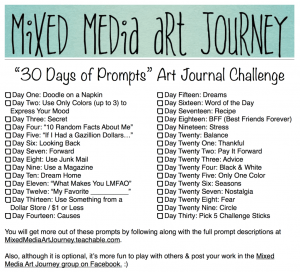
To promote artful learning in your classroom, we can introduce the concept of art journaling with some examples we can find on the internet. Then, we can ask our students to keep an artful journal throughout the week outside class. Giving about 10 minutes to our students on Monday lessons to share what they have on their journals not only gets them warmed up for the lesson but also encourages them to continue with their artwork.

Alternatively, we can set an “Art Journal Challenge” in our class by using the prompts below or creating our own 30 days of prompts together.

Why don’t we start your creative habit today?